Showing posts with label #customer service. Show all posts
Saturday, November 28, 2015
Are Your Customer Service Skills Where They Should Be?
Most customer service people are excited about their first day at their new job.They go to work ready to hit the road running,and for the next few months, their days are filled with interesting things to do and learn, and new people to talk with. As they start working with their customers, they probably even exceed their own expectations with the level of customer service they’re providing. They do it because they understand the importance of first impressions. But sooner or later, the newness of the job—or customer—wears off, the day-to-day demands of the job settle in, and all the extra customer service they went out of their way to provide in the beginning starts getting old.
When a customer calls and you say you’ll get back to them,don't push the request to the side. If you do before you know it, two days have passed, and the next conversation you have with their customer starts off with a litany of excuses—sometimes lies—rather than informed and articulate answers. If you want to be thought of as a superstar when it comes to customer service, handle the promises with a professional attitude toward solving the problem and keep your promises to the customer.
Take full responsibility for your own customer service skills. Customer service is not always an easy job. It can be fun when everything is going great, but not so much when there’s a problem.As a customer service professional you already may know the basics of customer service, but do you read the occasional article about trends in customer service? Do you ever take the time to honestly reflect on how your customers might view your customer service skills? Do you have at least one customer service role model who excels at customer service?
Customer service is more than just problem solving. Every conversation, message, and email you are connected with represents not just your skill at it, but also how important you think it is. Your good customer service will give your customer every reason to feel respected and appreciated. When your customer service skills are excellent, you’ll be well on your way to building longterm profitable business relationships.
Are your customers dealing with a different version of you after they’ve done business with you for some time? Here a three tips of advice.
1. If you are having a bad day, it's not your customer fault. Suck it up and put on a smile and make their interests, concerns, or problems yours, and do it happily.
2. From the moment you say hello until you say goodbye you are being judged for better or for worse. Surly you don't want to be the main topic at their business meetings as a bad example of poor customer service.
3. Good morning, good afternoon, thank you for your business, we look forward to working with you are words dear to your customer ears and go a long way.
Most of all if you are burned out, no longer care for the job (and customer service is about one of the most demanding) talk to the person in the company that can help you get over those hurdles. If you don't, the customers will go away and with it their revenue and with it your job. So remember , make everyday a great selling day!
Alan Luoma is a Sales Coach with extensive experience in industrial sales, sales management, new product development, sales and product training. He works with a national sustainable packaging company and their distributors to increase sales. Alan is an expert that speaks on eliminating behaviors that prevent you from being successful in sales and uncovering sales prevention departments that hinder your success. He is a member of the Hartford Springfield Speakers Network, The National Speakers Association and New England Speakers Association. You can view his profile on LinkedIn, or contact him at Luoma@snet.net
Wednesday, June 17, 2015
ODE TO PHEBE CANFIELD CAMP---AND TO US
Probably because of last
month’s holiday, I awoke this morning thinking of my home town, Durham,
Connecticut. All during my grade school years I marched in the Memorial Day
parade, which always ended in front of the cemetery. Although we knew my mother’s
side of the family had been in New England since before the Revolutionary War, it wasn’t
until the 1990’s that I discovered that one of my eighth great grandmothers, Phebe Canfield Camp, is interred in that cemetery. I doubt my mother was aware we had such deep roots
in the town.
I've often lauded the bravery required of and exhibited by women living in the
New World during the 1700’s and before, when the entire population of settlers
was under 300,000, and creature comforts were few. Women routinely faced death
by starvation or childbirth, or infections, or by the hands of the original
inhabitants. Getting water for drinking, cooking, bathing and laundering
must have required daily acts of determination and even heroism.
In 2015 our U.S.
population is over 300 million. Women
share personal and intimate information in the ether for anyone in the entire world
(and beyond?) to see and use. We typically drive personal transportation machinery at speeds
of 60 or more miles per hour. We trust our safety to strangers who pilot us through
the air. We expose our bodies in a way Phebe could not have condoned
or even imagined, and we may elect to raise children without benefit of a
husband in the home. We are confident we can provide a living for our families.
On this day, June 17th, a new thought
occurs to me. If Phebe were here now she might laud our everyday
brand of bravery. It requires different skills than she needed, but our bravery is equally impressive.
Sunday, May 17, 2015
MISSING THE BOAT
It is my belief that I am an
effective coach, mentor, instructor, because so much of what I teach about
customer service and Emotional Intelligence did not come naturally to me. I have
had to learn some concepts the hard way, questioning them and grappling with them
until they made sense to me. This has
helped me to understand and empathize with clients who have difficulty grasping
a point. It keeps me from ever trivializing someone’s lack of understanding. Many
managers, professors, customers, mentors, and coworkers have had a part in my training. I’d like to tell you about one coworker, Edythe.
Many years after we
had worked together I was having lunch with a friend in a Simsbury restaurant. There
was Edythe, sitting with a woman who was wearing scrubs. I recognized her immediately. When the other woman
left the table for a moment, I went over and introduced myself. I reminded Edythe where we had worked, and expressed
my gratitude for the huge impact she had on my professional growth over the
years.
Edythe gave me an
uncomprehending smile and looked around nervously for the other woman. It
became clear to me that in her current condition she was unable to understand who I was, or why I had approached
her. She seemed agitated, so I apologized for bothering her and returned to my
table, having forever missed the opportunity to thank her. That was probably her final lesson for me, which
I share with you in Edythe’s honor. 
Workshops
and Seminars in all facets of Emotional Intelligence Development
Email: Jeannie@JZNAssociates.com
Connect on LinkedIn www.linkedin.com/in/jeannienewman/Email: Jeannie@JZNAssociates.com
Labels:
#coach,
#coaching #sales,
#coworker,
#customer,
#customer service,
#Emotional Intelligence,
#empathize,
#gratitude,
#instructor,
#internalize,
#lesson,
#mentor,
#professor,
#social skills,
#teach
Sunday, May 3, 2015
How Custom Do You Treat Your Customer?
As a customer, nothing irks me more than the feeling of being used: that a business just sees me as a source of revenue.
Want to tick me off? Keep me nameless, faceless, and generic.
I'll admit it: I want to feel special. Unique.
And the irony is I'm not the only one. The want to feel special is driven by the universal human need for significance. That who I am and what I do matter.
When it comes to poor customer service, we, the discontented, don't have to put up with it any longer. In this equal access to information and social media, customers like me have too many options to stick around and put up with being treated poorly. If we don't like you, we'll tell a friend or two....thousand.
The challenge for business leaders is to figure out what to do to turn your customers into advocates, and then raving fans.
It starts with giving them a incredible experience of your product or service: one that they can't get anywhere else.
But that's not enough. Then, you have to stay connected to your fans, and create real relationships with them. You have to communicate with them in a way that makes them feel special and better from each touch point they have with you.
Possibly no one has mastered the art of making their fans feel special better than Lucasfilm: the guardians of the Star Wars franchise.
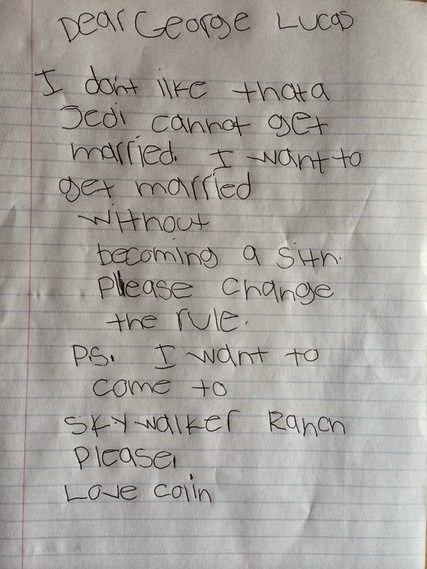
A recent New York Times article featured Lucasfilm's expertise in responding to their customer's needs. In addition to hosting a "Star Wars Celebration" every other year that draws close to 50,000 fans, Lucasfilm has a full time staff that answers fan mail. And not just with a generic follow up letter. Here's a terrific example:
Colin, the writer of the letter, is a 7 year old boy. He was disturbed to learn that Jedi can't get married. Lucasfilm's reply:
A personal, thoughtful letter, phrased as written to a young Jedi in training. Perfect.
What suggestions do you have to help someone be more "custom" to their customers?
Join the conversation by leaving a comment below.
If you enjoyed this post, please share with your network. Also, you can access more than 300 other articles on my website, and connect on LinkedIn.
Want to tick me off? Keep me nameless, faceless, and generic.
I'll admit it: I want to feel special. Unique.
And the irony is I'm not the only one. The want to feel special is driven by the universal human need for significance. That who I am and what I do matter.
When it comes to poor customer service, we, the discontented, don't have to put up with it any longer. In this equal access to information and social media, customers like me have too many options to stick around and put up with being treated poorly. If we don't like you, we'll tell a friend or two....thousand.
The challenge for business leaders is to figure out what to do to turn your customers into advocates, and then raving fans.
It starts with giving them a incredible experience of your product or service: one that they can't get anywhere else.
But that's not enough. Then, you have to stay connected to your fans, and create real relationships with them. You have to communicate with them in a way that makes them feel special and better from each touch point they have with you.
Possibly no one has mastered the art of making their fans feel special better than Lucasfilm: the guardians of the Star Wars franchise.
A recent New York Times article featured Lucasfilm's expertise in responding to their customer's needs. In addition to hosting a "Star Wars Celebration" every other year that draws close to 50,000 fans, Lucasfilm has a full time staff that answers fan mail. And not just with a generic follow up letter. Here's a terrific example:
Colin, the writer of the letter, is a 7 year old boy. He was disturbed to learn that Jedi can't get married. Lucasfilm's reply:
A personal, thoughtful letter, phrased as written to a young Jedi in training. Perfect.
What suggestions do you have to help someone be more "custom" to their customers?
Join the conversation by leaving a comment below.
If you enjoyed this post, please share with your network. Also, you can access more than 300 other articles on my website, and connect on LinkedIn.
Saturday, April 11, 2015
April’s Special Day - Take the Pledge
I joined friends for the spring breakfast at the YMCA. What
fun it was to say to one friend “yes this is a delicious breakfast but I’m
afraid to tell you that something seems to be crawling on your plate.” As she
carefully examined her food, I said “April Fool. “She replied “you got me.” We
laughed and moved on.
How many times do we have an opportunity to tell someone
they are a fool and then laugh about it? We have one day a year for such
foolishness and that is April first, April fool’s Day. There are many stories
and thoughts about how this worldwide prank day came to be celebrated. Feeling
spring in the air is probably one of the best explanations for me.
There is however, a day of great importance in April, that everyone needs to be aware of, and no it’s not tax day, you already know about that one! It is a day with a history behind it. It started as National Secretary's Day in 1952. The concept was created by Harry F. Klemfuss of Young and Rubicam Advertising agency. He was in Public Relations and thought that Secretaries needed to be recognized for their great contribution to the many businesses, corporations and non-profit agencies where they worked. I remember one Secretaries Day speaking for a city Chamber of Commerce when women picketed outside saying the name should be changed. It was only a few years later that the day became National Assistants Day. They spoke up and things changed.
However, many Assistants today find themselves doing the work of two people and many times taken advantage of, yelled at, bullied and stimulated to live in fear. As the Communication LifeStyle Expert™ I see Personal, Administrative and Executive Assistants who live in fear, have a LifeStyle of overwork, and underpay with thoughts of losing their job if they speak up. This of course affects their Health and therefore their LifeStyle.
That is why I was excited to stand with Bonnie Low-Kramen Speaker and Author of Be the Ultimate Assistant as she launched her Speak up Pledge campaign at the Today Show in Rockefeller Plaza on April 2. Bonnie, the Ultimate Speaker herself and Assistant to Olympia Dukakis and her husband Louis Zorich for 25 years wants to have 1 million of you sign her Speak up pledge for better communication in the workplace. Most Administrative Professionals are women and they need to Speak up and Speak out so things can change for them and the workplace. So please go to http://WWW.Speakupledge.com and sign a pledge to Speak Up especially if you are staff or in management. This will make for a better workplace everywhere.
Oh! And don’t forget National Assistants Day which has now evolved to Administrative Professionals Day April 22 and now recognized as Administrative Professionals Week also. April 19-25 2015. Please share this with friends and peers worldwide. Thanks Bonnie for this much needed awareness of changes to be made. Personally I feel that if all Administrative Assistants and Administrative Professionals in the United States took the same day off, all businesses would collapse and our country would be in ruins
The Communication LifeStyle Expert™
Keynote/Breakout Speaker and Authority on Body Language
Tuesday, February 17, 2015
HOW TO GET RID OF THE IRATE CUSTOMER
Whenever we discuss customer service, the
subject of the irate customer arises. Some actually refer to the person as “the
Customer from Hell.” You will recognize the person immediately by their tone of voice, their words, and their body language. They have built up a good head of steam.
Wait a minute! If the customer
is in Hell, quite likely someone or something in your company drove them there.
This interaction is your opportunity to rescue them from Hell, alive and
appreciative, if at all possible.
When confronted with a customer who is
demonstrating emotion you must give
them the opportunity to work through the emotion before you can start problem
solving. Searching for a solution before the emotion is addressed can allow the
emotion to remain and fester.
Address the emotion, without
emphasizing it. You might say, “I can hear your frustration.” (But not,
“You sound angry enough to kill someone.” Why give them ideas?)
Invite them to tell you what is
happening. Say something like, “Could you please tell me exactly what
happened?”
Validate what they are feeling. “The delivery arrived too late for the party?
No wonder you were frustrated.” Or, "I'd feel that way, too."
Actively Listen to them. If you
are face to face, make eye contact, nod encouragingly. If you are on the phone,
say that you understand, or make sounds of empathy. This assures the customer
that you are engaged, and have not put the phone down and walked away. It may
be appropriate to let the customer know you are taking notes.
Withhold Your Own Emotion. The
customer has enough emotion for both of you. You are not to emote, not to
defend (or blaspheme) a coworker or company policy. If you feel you are being verbally attacked, set that aside for the moment. One of you needs to be
analytical and dispassionate, and that’s you.
Nonjudgmentally Rephrase what you heard
as opportunity presents. “Sounds as though” or perhaps, “If I heard you
correctly…”
Partner toward Possible Solutions: Once the emotion has been addressed, and only then, you can begin to work with your customer on a mutually satisfactory solution. That is how you get rid of the customer from Hell~~by respectfully leading them out of Hell and back to the world of working partnerships.

Jeannie Newman, founder and president of JZN Associates, is the go-to person for all your group's Emotional Intelligence needs. She brings her experience, compassion, and sense of humor to the arena of social skills. She is available for guided discussions, workshops, and seminars on all related topics. Not sure if she can help your group? Attend one of her talks. Find out more at JZNAssociates.com; join her on LinkedIn.
Saturday, January 17, 2015
FIVE USEFUL TOOLS
Last month I assured
you that a complaining customer is actually a gift, in part because you cannot
correct a problem until you know that one exists.There is another reason for you to welcome the complaining customer: The fact that your customer chooses to engage with you is evidence of their loyalty to your company. Whether or not you are able to solve the customer’s initial complaint, your conversation with them is your opportunity to strengthen the bond they share with you.
When you or your staff
lack the training to manage a customer complaint, you might shy away from it,
or mishandle it, either of which results in a less than positive outcome. So
here are five useful tools for you.
1. Greet the complainer
in a warm and professional manner, putting aside any bias about the validity of
the complaint.
Until your staff learn
proper techniques, they are at risk of reverting to childhood default
mechanisms, which involve self-defense, or denying responsibility, or turning
blame back on the customer. That’s when they
are most at risk of uttering pathetic responses like, “That wasn’t’ my fault,” or, “It’s always been done
that way,“ or, “Nobody else has had a problem with it.” These are not
relationship building mindsets. The best way to nurture the relationship~~and your
bottom line, for that matter~~is by responding to the concerns with respect and an open mind.
2. Practice active
listening techniques.
3. Explain your next
action step and time line.
4. Thank the customer for
bringing this to your attention!
Whether you agree with
them or not, they have let you know that they care enough about your company to
go to the trouble of contacting you. Nurture that!
5. Follow through.
The follow through is as
important as the expression of gratitude. If you fail to keep your word, you
have effectively sabotaged your entire effort. We have been discussing a complaint made by a fairly dispassionate customer, as opposed to an irate customer. That scenario will be discussed in a future post.
In the meantime~~~Happy weekend to all!
in both the for profit and non-profit arenas. Find her at JZNAssociates.com.
Subscribe to:
Posts (Atom)